Showing posts with label 03 SOLUTIONS. Show all posts

Tuesday, August 9, 2016

What Makes a Successful Place? - Project for Public Spaces

Great public spaces are those places where celebrations are held, social and economic exchanges occur, friends run into each other, and cultures mix. They are the “front porches” of our public institutions – libraries, field houses, schools – where we interact with each other and government. When theses spaces work well, they serve as the stage for our public lives.  

In evaluating thousands of public spaces around the world, PPS has found that to be successful, they generally share the following four qualities: they are accessible; people are engaged in activities there; the space is comfortable and has a good image; and finally, it is a sociable place: one where people meet each other and take people when they come to visit. PPS developed The Place Diagram as a tool to help people in judging any place, good or bad:


To read click here: What Makes a Successful Place?


Tuesday, July 19, 2016

The Basque Declaration

The Basque Declaration outlines new pathways for European Cities and Towns to create productive, sustainable and resilient cities for a liveable and inclusive Europe. The document aims to support and accelerate socio-cultural, socio-economic and technological transformation. The Basque Declaration was acclaimed by the participants of the 8th European Conference on Sustainable Cities & Towns held in the Basque Country.  April 2016

The Basque Declaration
We understand the need for transformation in order to:
1. Decarbonise our energy systems and reduce total energy consumption
2. Create sustainable urban mobility patterns and accessibility for all
3. Protect and enhance biodiversity and ecosystem services
4. Reduce the use of greenfield land and natural space
5. Protect water resources, water and air quality
6. Adapt to climate change, and reduce the risk of disasters
7. Improve public space to create convivial, safe, and vibrant environments
8. Provide sufficient and adequate housing for all
9. Guarantee the social inclusion and integration of all parts of the society
10. Strengthen our local economies and local employment opportunities


Friday, July 15, 2016

Stakeholder Engagement: A Good Practice Handbook for Companies Doing Business in Emerging Markets - IFC

This handbook endeavors to provide a comprehensive overview of good practice in stakeholder engagement, with a dedicated focus on stakeholder groups that are "external" to the core operation of the business, such as affected communities, local government authorities, non-governmental and other civil society organizations, local institutions and other interested or affected parties.

The handbook is divided into two parts: Part One contains they key concepts and principles of stakeholder engagement, the practices that are known to work, and the tools to support the delivery of effective stakeholder engagement. Part Two shows how these principles, practices and tools fit with the different phases of the project cycle, from initial concept, through construction and operations, to divestment and/or decommissioning.

To read click here: 


Friday, June 24, 2016

Global Trends in Renewable Energy Investment Report 2016

The Global Trends in Renewable Energy Investment report (GTR), formerly Global Trends in Sustainable Energy Investment, was first published by the Frankfurt School–UNEP Collaborating Centre for Climate & Sustainable Energy Finance in 2011. This annual report was produced previously (starting in 2007) under UNEP’s Sustainable Energy Finance Initiative (SEFI). It grew out of efforts to track and publish comprehensive information about international investments in renewable energy. The latest edition of this authoritative annual report tells the story of the most recent developments, signs and signals in the financing of renewable power and fuels. It explores the issues affecting each type of investment, technology and type of economy.  

To read  lick here: 


Tech Trends 2016 Innovating in the digital era - Deloitte

The theme of this year’s report is innovating in the digital era, which is inspired by the opportunities today’s CIOs—across industries, geographies, and company sizes—have to shape tomorrow for every corner of their organizations by transforming “business as usual.” These leaders are in a rare position to imagine a future, and then harness innovation to build it responsibly from the realities of today.
 
Tech Trends features perspectives from client executives, industry and academic luminaries, and our global network of Deloitte professionals, all exploring major trends that are helping organizations innovate in the digital era. The report also examine the roadmaps and investment priorities of start-ups, venture capitalists, and leading technology vendors.


Thursday, June 23, 2016

Global Human Capital Trends 2016 The new organization: Different by design - Deloitte.

The theme of this year’s report—“The new organization: Different by design”— reflects a major finding: After three years of struggling to drive employee engagement and retention, improve leadership, and build a meaningful culture, executives see a need to redesign the organization itself, with 92 percent of survey participants rating this as a critical priority. The “new organization,” as we call it, is built around highly empowered teams, driven by a new model of management, and led by a breed of younger, more globally diverse leaders.

Contents:

The new organization | Different by design Organizational design | The rise of teams Leadership awakened | Generations, teams, science Shape culture |  Drive strategy Engagement |  Always on Learning | Employees take charge Design thinking |  Crafting the employee experience HR | Growing momentum toward a new mandate People analytics |  Gaining speed Digital HR |  Revolution, not evolution The gig economy |

To read click here: 


Friday, June 17, 2016

The Metropolitan Century - OECD

The report provides an outline of recent and likely future urbanisation trends and discusses the consequences. The world is in the middle of an urbanisation process that will cause urbanisation rates to rise from low double digit rates to more than 80% by the end of the century. It argues that this is both a great opportunity and a great challenge, as decisions taken today will affect the lifes of people for a long time to come. 
The report aims at explaining why cities exist, and what can make them prosperous and function well. It also discusses whether cities are good for residents, for the countries they are located in and for the global environment. The report argues that cities exist and grow because they are a source of economic prosperity and offer amenities that benefit their residents. It concludes that urbanisation is a process that needs to be shaped by policy makers to ensure that all benefit from it.  
To read click here:  The Metropolitan Century


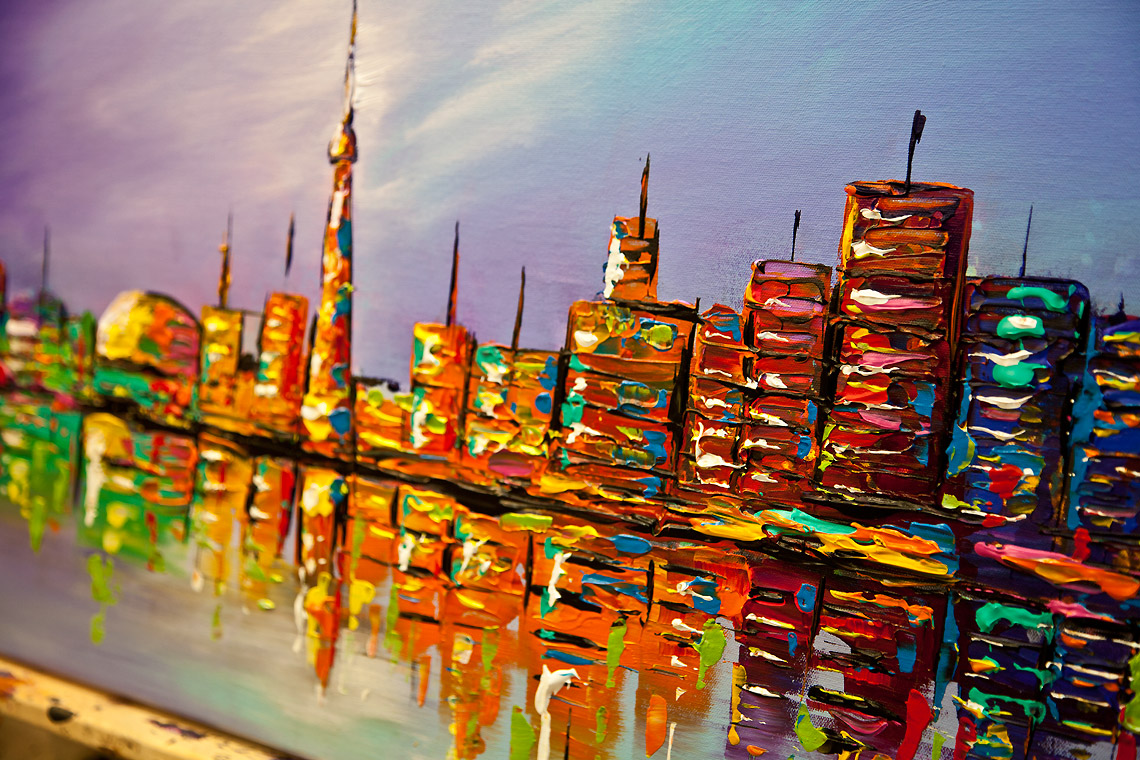
City Art / Toronto, San Francisco, Paris, NYC / Osnat

Osnat is a self-representing Canadian artist. She is best known for her large-size original abstract landscape and Contemporary modern paintings, but she mostly enjoys the combination of these three.

As an artist who sells on and off eBay for more than seven years now, Osnat strives for the best quality in both materials and finish. All herpaintings are created with great care and are coated with varnish to protect the colors for extended time, and to ensure durability and protection against changes in room temperature.
Among her styles you can find Original Abstract Art paintings, Decorative art, Cityscape, Abstract Fine Art, Modern Abstract Art, Contemporary Abstract Art, Landscape, Abstract Nature art, Abstract Original Artwork, Figures, Dune art, Geometric art, Blooming trees, Floral art and Seascape art. Most of Osnat's paintings and ideas are inspired by the nature around her, human emotions, sensibility, and invigoration. This inspiration is well emphasized by the titles of her creations.

To see more click here: Osanat Fine Art


Tuesday, June 14, 2016

Public-Private Dialogue Handbook - PPD

The Public-Private Dialogue Handbook a Toolkit for Business Environment Reformers is a practical guidance and advice to stakeholders who want to build and maintain public-private dialogue. 

This handbook draws from studies of PPD experiences around the world. It offers practical guidance on identifying and avoiding common pitfalls and maximizing the payoffs that dialogue can bring.1 The authors aim not to promote a single way to conduct PPD but rather to expose practitioners to a variety of implementation options to choose from.


Sendai Framework for Disaster Risk Reduction 2015 - 2030 - UNITED NATIONS

The Sendai Framework is built on elements which ensure continuity with the work done by States and other stakeholders under the HFA and introduces a number of innovations as called for during the consultations and negotiations.

The Sendai Framework also articulates the following: the need for improved understanding of disaster risk in all its dimensions of exposure, vulnerability and hazard characteristics; the strengthening of disaster risk governance, including national platforms; accountability for disaster risk management; preparedness to “Build Back Better”; recognition of stakeholders and their roles; mobilization of risk-sensitive investment to avoid the creation of new risk; resilience of health infrastructure, cultural heritage and work-places; strengthening of international cooperation and global partnership, and risk-informed donor policies and programs, including financial support and loans from international financial institutions.

To read click here: 


Friday, June 10, 2016

The Infrastructure 100: World Cities Edition - KPMG

The Infrastructure 100: World Cities Edition initiative is a high-profile report showcasing 100 of the most innovative and inspiring urban infrastructure projects from around the world.

The selected projects were then sorted into 10 project categories, including:
  • Urban Mobility
  • Global Connectivity
  • Urban Regeneration
  • Education
  • Healthcare
  • Water
  • New and Extended Cities
  • Recycling and Waste Management
  • Urban Energy Infrastructure
  • Communications Infrastructure

Ultimately, the projects selected for the Infrastructure100: World Cities Edition are innovative and inspiring examples of infrastructure projects that make great cities – places where people want to live and do business.


Thursday, June 9, 2016

Future State 2030: The Global Megatrends Shaping Governments - KPMG

KPMG International engaged the Mowat Centre at the School of Public Policy and Governance, University of Toronto, to conduct targeted research on megatrends that will significantly impact the business landscape for the public and private sector through to 2030. These findings will help guide important conversations over the coming years among national governments and public sector policy makers. The findings identity nine global megatrends that are most salient to the future of governments and their core responsibilities of economic prosperity, security, social cohesion and environmental sustainability.
The identified megatrends encompass some of the world's most critical challenges, including:
  • Resource scarcity
  • Demographic changes
  • Rise of the middle class
  • Economic power shift
  • Urbanization and climate change 
    To read click here: 


A Tale of Two Futures: Sustainable Buildings or Unsustainable Climate Change - RMI

Today's existing buildings use 72% of our nation's electricity, much of which is wasted. We cannot transform our energy system and prevent runaway climate change if America's commercial buildings continue to consume dirty fossil fuels at today's rates. 


Rocky Mountain Institute (RMI) is an independent, non-partisan nonprofit that drives the efficient and restorative use of resources. Co-founded in 1982 by Amory Lovins, its Chairman Emeritus and Chief Scientist, RMI now has approximately 150 full-time staff, annual operations of $30 million, and a global reach and reputation.

Thursday, June 2, 2016

The Age of Collaboration - Arthur D. Little

This report is based on the first global, all-stakeholder encompassing research conducted over the past months and our extensive experience in this field. In total close to 2,000 hours were contributed by the various stakeholders.

The report summarizes our findings and is for anyone interested in corporate-startup collaboration. You should in particular read on, if you are interested in: 

  • Understanding the shift from the “age of disruption” to the “age of collaboration” 
  • Understanding the challenges for both startups and corporates to deal with today’s increasingly challenging business world  
  • Understanding how to initiate, conclude and manage the collaboration between startups and corporates to ensure value creation for all players.


Wednesday, June 1, 2016

EVENTS/5th GRI Global Conference

GRI convened its 5th Global Conference: Empowering Sustainability Decisions, 18 - 20 May 2016 in Amsterdam. 1200 delegates from more than 70 countries, attended the conference, which showcases more than 200 speakers. This video presents some of the highlights of the conference, including insights from each of the four inspiring plenary sessions.  

To watch click here:


Tuesday, May 31, 2016

Report of the World Commission on Environment and Development: Our Common Future

Our Common Future, also known as the Brundtland Report, from the United Nations World Commission on Environment and Development(WCED) was published in 1987.

Its targets were multilateralism and interdependence of nations in the search for a sustainable development path. The report sought to recapture the spirit of the [[United Nations by shivang dubey and radhika rahti Conference on the Human Environment]] - the Stockholm Conference - which had introduced environmental concerns to the formal political development sphere. Our Common Future placed environmental issues firmly on the political agenda; it aimed to discuss the environment and development as one single issue.

The document was the culmination of a “900 day” international-exercise which catalogued, analysed, and synthesised: written submissions and expert testimony from “senior government representatives, scientists and experts, research institutes, industrialists, representatives of non-governmental organizations, and the general public” held at public hearings throughout the world.

To read click here:  


Part I. Common Concerns 1. A Threatened Future I. Symptoms and Causes II. New Approaches to Environment and Development 2. Towards Sustainable Development I. The Concept of Sustainable Development II. Equity and the Common Interest III. Strategic Imperatives IV. Conclusion 3. The Role of the International Economy The International Economy, the Environment, and Development I. II. Decline in the 1980s III. Enabling Sustainable Development IV. A Sustainable World Economy

Part II. Common Challenges 4. Population and Human Resources I. The Links with Environment and Development II. The Population Perspective III. A Policy Framework 5. Food Security: Sustaining the Potential I. Achievements II. Signs of Crisis III. The Challenge IV. Strategies for Sustainable Food Security V. Food for the Future 6. Species and Ecosystems: Resources for Development I. The Problem: Character and Extent II. Extinction Patterns and Trends III. Some Causes of Extinction IV. Economic Values at Stake V. New Approach: Anticipate and Prevent VI. International Action for National Species VII. Scope for National Action VIII. The Need for Action 7. Energy: Choices for Environment and Development I. Energy, Economy, and Environment II. Fossil Fuels: The Continuing Dilemma III. Nuclear Energy: Unsolved Problems IV. Wood Fuels: The Vanishing Resource V. Renewable Energy: The Untapped Potential VI. Energy Efficiency: Maintaining the Momentum VII. Energy Conservation Measures VIII. Conclusion 8. Industry: Producing More With Less I. Industrial Growth and its Impact II. Sustainable Industrial Development in a Global Context III. Strategies for Sustainable Industrial Development 9. The Urban Challenge I. The Growth of Cities II. The Urban Challenge in Developing Countries III. International Cooperation

Part III. Common Endeavours 10. Managing The Commons I. Oceans: The Balance of Life II. Space: A Key to Planetary Management III. Antarctica: Towards Global Cooperation 11. Peace, Security, Development, and the Environment I. Environmental Stress as a Source of Conflict II. Conflict as a Cause of Unsustainable Development III. Towards Security and Sustainable Development Towards Common Action: Proposals For Institutional and Legal Change 12. I. The Challenge for Institutional and Legal Change II. Proposals for Institutional and Legal Change III. A Call for Action.

Annexes. Annexe 1: Summary of Proposed Legal Principles for Environmental Protection and Sustainable Development Adopted by the WCED Experts Group on Environmental Law Annexe 2: The Commission and its Work.


Friday, May 27, 2016

City Art / Paris, Rome, NYC/ Kal Gajoum

Kal Gajoum is an artist from Tripoli, Libya who currently resides in British Columbia, Quebec, Canada. His interest in art started at a very early age by practicing oil painting and palette knife techniques. He learned watercolour techniques and the Parisian style of painting from a private artist. Now he concentrates on cityscapes and still life oil on canvas paintings.

To see click here: Kal Gajoum


Friday, May 20, 2016

SUSTAINABILITY STANDARDS/Cities Prosperity Initiative Toolkit

UN-Habitat’s “City Prosperity Initiative” is a strategic measurement, monitoring, and policy tool for cities that are committed to adopt a more holistic, people-centred, and sustainable notion of prosperity and that pledge to deploy the necessary efforts and resources to move forward on the prosperity path.

General Objectives
  • Globally mainstream a fresh approach to prosperity that is holistic and integrated, and which is essential for the promotion of collective well-being and fulfillment for all.
  • Help cities to steer the world towards economically, socially, politically, and environmentally prosperous futures.
  • Catalyze the policies and actions of cities towards the prosperity path, and create conditions to measure current and future progress.
    To read click here: Cities Prosperity Initiative Toolkit


Tuesday, May 17, 2016

BIO/Joseph Bazalgette (UK)

As chief engineer to London's metropolitan board of works in the mid-19th century, Bazalgette had a significant impact both on London's appearance and, through his design of an efficient sewage system, on the health of its inhabitants.

In the mid-19th century, London was suffering from recurring epidemics of cholera. In 1853 - 1854 more than 10,000 Londoners were killed by the disease. It was thought at the time to be caused by foul air. The hot summer of 1858 created the 'Great Stink of London', which overwhelmed all those who went near the Thames - including the occupants of Parliament. This, together with the frequent occurrence of cholera, gave impetus to legislation enabling the metropolitan board to begin work on sewers and street improvements. By 1866 most of London was connected to a sewer network devised by Bazalgette.  Joseph Bazalgette was born in London on 28 March 1819 and died on 15 March 1891. Info: BBC History

To read click here: Joseph Bazalgette (1819 - 1891)


Guide to Corporate Sustainability - United Nations Global Compact

Lays out five defining features of corporate sustainability, which the Global Compact asks businesses to strive towards – looking at why each element is essential, how business can move forward and what the Global Compact is doing to help.
Contents:
  • What is Corporate Sustainability?
  • The power of principles
  • Everyone benefits from a better world
  • Leading for the long term
  • Transparency builds trust
A local lens for global change