Showing posts with label THE ABC. Show all posts

Thursday, February 22, 2024

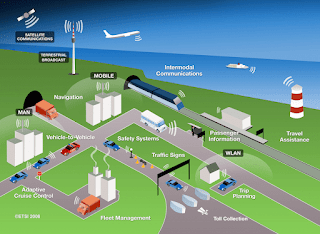
THE ABC/ Intelligent Transportation Systems (ITS)


Intelligent transportation systems are advanced applications which, without embodying intelligence as such, aim to provide innovative services relating to different modes of transport and traffic management and enable various users to be better informed and make safer, more coordinated, and ‘smarter’ use of transport networks. Intelligent Transport Systems (ITS) can significantly contribute to a cleaner, safer and more efficient transport system.


THE ABC FOR SUSTAINABLE CITIES
UNEP / UN HABITAT / FIDIC / GI-REC

Based on

Thursday, March 23, 2017

THE ABC/ Information and communications technology (ICT)

Information and communications technology (ICT) is often used as an extended synonym for information technology (IT), but is a more specific term that stresses the role of unified communications and the integration of telecommunications (telephone lines and wireless signals), computers as well as necessary enterprise software, middleware, storage, and audio-visual systems, which enable users to access, store, transmit, and manipulate information.  

THE ABC FOR SUSTAINABLE CITIES
UNEP / UN HABITAT / FIDIC / GI-REC


Tuesday, March 21, 2017

THE ABC/ Informal Settlements

Informal Settlements are areas where housing units have been constructed on land that the occupants have no legal right to or/and unplanned settlements where housing is not in compliance with current planning and building regulations.

Based on


THE ABC/ Hypermobility

The notion that more travel at faster speeds covering longer distances generates greater economic prosperity. With approximately 7.5 billion trips being made each day in 2005, this is increasingly a distinguishing feature of urban areas.

THE ABC FOR SUSTAINABLE CITIES
UNEP / UN HABITAT / FIDIC / GI-REC

Based on
UN-Habitat 2013, Planning and Design for Sustainable Urban Mobility: Global Report on Human Settlements

THE ABC/ Household Waste

Household waste is waste material usually generated in the residential environment. Note: A holistic approach to waste management has positive consequences for GHG emissions from the energy, forestry, agriculture, mining, transport, and manufacturing sectors. The climate benefits of waste practices result from avoided landfill emissions, reduced raw material extraction and manufacturing, recovered materials and energy replacing virgin materials and fossil-fuel energy sources, carbon bound in soil through compost application, and carbon storage due to recalcitrant materials in landfills. The European Union’s approach to waste management five-step waste hierarchy where prevention is the best option, followed by re-use, recycling and other forms of recovery, with disposal such as landfill as the last resort. 

THE ABC FOR SUSTAINABLE CITIES
UNEP / UN HABITAT / FIDIC / GI-REC

THE ABC/ Carbon Tax

Carbon tax is a tax on the use of fossil fuel based on the relative carbon content of those fuels.

 THE ABC FOR SUSTAINABLE CITIES
UNEP / UN HABITAT / FIDIC / GI-REC

Based on:

Wednesday, December 28, 2016

THE ABC/ Hazardous Waste

A used or discarded material that can damage human health and the environment. Hazardous wastes may include heavy metals, toxic chemicals, medical wastes or radioactive material. The fastest growing waste stream in both developing and developed countries concerns electrical and electronic products, which contain hazardous substances that make disposal even more of a challeHuman health and the environment are increasingly at risk, particularly when dumpsites are uncontrolled or volume becomes unmanageable. Illnesses and infections, ground water pollution, GHG emission, and ecosystem destruction are just some of the impacts of our overfilled global dustbin. The goal is to produce as little waste as possible, recycle or remanufacture as much as possible, and treat any unavoidable waste in a manner that is the least harmful to the environment and humans—or even as a source of sustainable energy.

THE ABC FOR SUSTAINABLE CITIES
UNEP / UN HABITAT / FIDIC / GI-REC


THE ABC/ Hazard

Hazard refers to a dangerous phenomenon, substance, human activity or condition that may cause loss of life, injury or other health impacts, property damage, loss of livelihoods and services, social and economic disruption, or environmental damage. Towns and urban agglomerations are affected by natural disasters. Large cities and mega-cities concentrate and magnify risk, but smaller cities also suffer from exposure to multiple risks. Involvement in reconstruction and rehabilitation efforts in urban and peri-urban areas has become increasingly significant as emergency shelter to more permanent housing solutions following a disaster, sustainable neighbourhoods and integrated settlement approaches including construction materials and technologies, energy efficiency and ecological aspects, alternative water supply and sanitation systems, solid waste and environmentally friendly site management in high-risk and poor-income areas etc.


THE ABC FOR SUSTAINABLE CITIES
UNEP / UN HABITAT / FIDIC / GI-REC


THE ABC/ Habitat conferences (e.g. Habitat III)

The Habitat Conferences are conferences convened by the United Nations General Assembly every 20 years since 1976 on issues related to urbanisation and sustainable human settlements. Habitat III (aka the United Nations Conference on Housing and Sustainable Urban Development) will take place in Quito, Ecuador, from 17 – 20 October 2016. Member States of the General Assembly, in resolution 67/216, decided that the objective of the Conference are to secure renewed political commitment for sustainable urban development, assess accomplishments to date, address poverty and identify and address new and emerging challenges. 

THE ABC FOR SUSTAINABLE CITIES
UNEP / UN HABITAT / FIDIC / GI-REC

Wednesday, December 21, 2016

THE ABC/ Greenhouse Gas

Greenhouse gases are those gaseous constituents of the atmosphere, both natural and anthropogenic, that absorb and emit radiation at specific wavelengths within the spectrum of terrestrial radiation emitted by the Earth’s surface, the atmosphere itself, and clouds. This property causes the greenhouse effect. Water vapour (H2O), carbon dioxide (CO2 ), nitrous oxide (N2O), methane (Ch4 ), and ozone (O3) are the primary greenhouse gases in the Earth’s atmosphere. Moreover, there are a number of entirely human-made greenhouse gases in the atmosphere, such as the halocarbons and other chlorine- and bromine-containing substances, dealt with under the Montreal Protocol. Beside CO2 , N2O, and Ch4 , the Kyoto Protocol deals with the greenhouse gases sulphur hexafluoride (SF6), hydrofluorocarbons (HFCs), and perfluorocarbons (PFCs). (1) The primary greenhouse gases in the Earth’s atmosphere are water vapour, carbon dioxide, methane, nitrous oxide, and ozone. [2] Greenhouse gas (GHG) is a gas, such as water vapour, carbon dioxide, methane, chlorofluorocarbons (CFCs) and hydro chlorofluorocarbons (HCFCs), that absorbs and re-emits infrared radiation, warming the Earth’s surface and contributing to climate change. Greenhouse gases are gases as carbon dioxide, nitrous oxide, methane, ozone and chlorfluorocarbons occurring naturally or from human activities and are contributing to the greenhouse effect (global warming).

THE ABC FOR SUSTAINABLE CITIES
UNEP / UN HABITAT / FIDIC / GI-REC
THE ABC/ Greenhouse Effect

The Sun powers Earth’s climate, radiating energy at very short wavelengths, predominately in the visible or near-visible (e.g., ultraviolet) part of the spectrum. Roughly one-third of the solar energy that reaches the top of Earth’s atmosphere is reflected directly back to space. The remaining two-thirds is absorbed by the surface and, to a lesser extent, by the atmosphere. To balance the absorbed incoming energy, the Earth must, on average, radiate the same amount of energy back to space. Because the Earth is much colder than the Sun, it radiates at much longer wavelengths, primarily in the infrared part of the spectrum (see Figure 1). Much of this thermal radiation emitted by the land and ocean is absorbed by the atmosphere, including clouds, and reradiated back to Earth. This is called the greenhouse effect. The glass walls in a greenhouse reduce airflow and increase the temperature of the air inside. Analogously, but through a different physical process, the Earth’s greenhouse effect warms the surface of the planet. Without the natural greenhouse effect, the average temperature at Earth’s surface would be below the freezing point of water. Thus, Earth’s natural greenhouse effect makes life as we know it possible. However, human activities, primarily the burning of fossil fuels and clearing of forests, have greatly intensified the natural greenhouse effect, causing global warming.

THE ABC FOR SUSTAINABLE CITIES
UNEP / UN HABITAT / FIDIC / GI-REC


Based on

Graphic: IPCC

THE ABC/ Greenfield land

Greenfield land is land on which no previous development has taken place.

THE ABC FOR SUSTAINABLE CITIES
UNEP / UN HABITAT / FIDIC / GI-REC

THE ABC/ Green Space Factor

It aims to secure a certain amount of green surface coverage in every building lot, and to minimise the degree of sealed or paved surfaces in the development. It is applied to the whole building lot, taking into account both the building areas and the open space. Developers describe their green gardening design, quality and proportion of surface etc.


THE ABC FOR SUSTAINABLE CITIES
UNEP / UN HABITAT / FIDIC / GI-REC


Based on


THE ABC/ Green roof

Green roof of a building that is partially or completely covered with seeded soil and vegetation laid over a waterproofing membrane. Green roof, or rooftop garden, is a vegetative layer grown on a rooftop. Green roofs provide shade and remove heat from the air through evapotranspiration, reducing temperatures of the roof surface and the surrounding air. On hot summer days, the surface temperature of a green roof can be cooler than the air temperature.

THE ABC FOR SUSTAINABLE CITIES
UNEP / UN HABITAT / FIDIC / GI-REC


Based on
 United States Environmental Protection Agency


THE ABC/ Green Infrastructure

Where as Infrastructures are defined as basic systems and services, such as transport and power supplies that a country or organisation uses in order to work effectively; green infrastructure brings nature into the city, which can improve both mental and physical health, increase property value, conserve energy, enhance wildlife habitat and save money on more costly pipe infrastructure.

THE ABC FOR SUSTAINABLE CITIES
UNEP / UN HABITAT / FIDIC / GI-REC

Thursday, December 8, 2016

THE ABC/ Green Building rating tool

Green building rating tools provide third-party validation of the design and/or performance of a building. Certification systems are vital as they provide an independent assessment of the green performance of projects; increasingly a key consideration for owners, tenants, agents and capital providers. Certification systems have been particularly successful in raising awareness of green buildings, resulting in greater market demand and industry response. By defining what is considered ‘green’ in a particular market, rating tools are able to recognize and reward best practice and thereby help move the entire market beyond simple code compliance. In more mature green building markets, building codes often become more stringent as the baseline for what is considered standard performance – at least as defined by ratings tools – increases. Green building rating tools also help create demand for green buildings. There are currently 31 different certification systems currently supported by Green Building Councils; the most widely used examples include LEED, GreenStar and BREEAM. The systems often serve as a guideline from the first day of planning and throughout the construction phase, and increasingly focus on life cycle analysis and the in use phase of the building life-cycle. Ratings tools create a common language around green building by providing definitions and performance benchmarks, which can provide verification for capital providers and developers. They have expanded the understanding of green building beyond simply energy or water efficiency in operations. Areas of building design and operation that were previously overlooked, such as indoor environment quality and the life-cycle of buildings materials, have gained attention in the market and in policy. Meeting a certification standard can be a means for contractual agreement between all players in the design and construction process, as well as potential policy targets for the public and private sectors. For example, many public authorities are adopting certification as a requirement, primarily in public buildings.

THE ABC FOR SUSTAINABLE CITIES
UNEP / UN HABITAT / FIDIC / GI-REC

THE ABC/ Green building

Green building is a holistic concept that starts with the understanding that the built environment can have profound effects, both positive and negative, on the natural environment, as well as the people who inhabit buildings every day. Green building is an effort to amplify the positive and mitigate the negative of these effects throughout the entire life cycle of a building. While there are many different definitions of green building out there, it is generally accepted as the planning, design, construction, and operations of buildings with several central, foremost considerations: energy use, water use, indoor environmental quality, material section and the building’s effects on its site.

THE ABC FOR SUSTAINABLE CITIES
UNEP / UN HABITAT / FIDIC / GI-REC


THE ABC/ Green belt

Green belt is a zone of land that encircles a city and on which development is forbidden.

THE ABC FOR SUSTAINABLE CITIES
UNEP / UN HABITAT / FIDIC / GI-REC